Learn Morse Code with Our Easy-to-Use Morse Code Generator and Translator
Introduction to Morse Code
It is the type of code used to communicate which involves dots and dashes (or other short or long signals) in order to communicate the letters, figures and punctuation marks. It was invented during the 1830s-1840s by Samuel F. B. Morse (together with his partner Alfred Vail) as part of the original commercial telegraph systems.
Even though today telegraphy is mostly substituted by digital communications, Morse code is still used in some niches. As an example, the radio-navigation aids (such as the VORs) continue to transmit station identifiers using Morse code, keeping the tradition of aviation and maritime usage.
Want to find out more? No matter whether you are a complete amateur or you already have the knowledge of the basics, our Morse code generator and translator tool is a quick, practical way of testing this old method of communication yourself.
How the Morse Code Generator & Translator Works
The Morse Code Generator & Translator involves a very easy and direct process. It is fast, simple, and convenient to read text in Morse code using our tool.
Here’s how to use it:
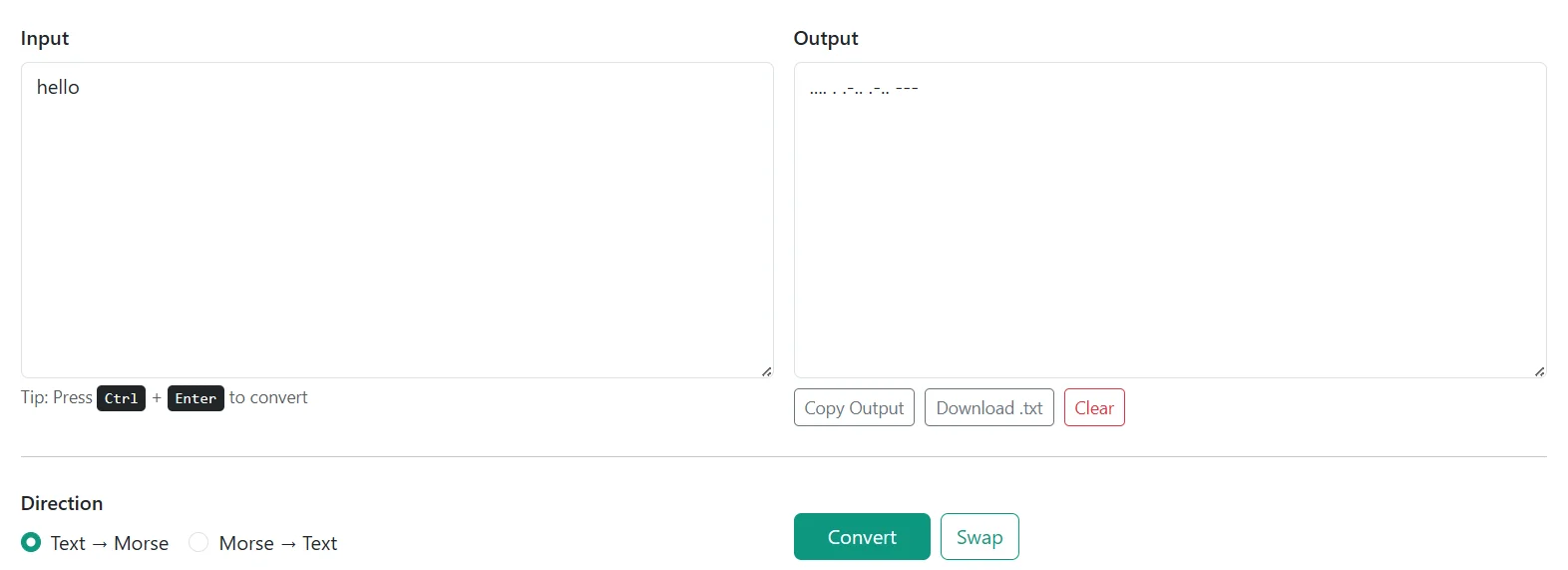
- Type in your text: type any English phrase or word into the input box (such as, hello or I love you).
- Text to Morse code: simply press the “Convert” button, and the tool will immediately display the Morse code version (new dots, dashes, and other suitable spacing).For example, “hello” becomes: .... . .-.. .-.. —
- Decode Morse code: Paste or type in a Morse code string (dots, dashes and spaces), press the button "Convert" in order to translate it back to English.
This lets you quickly encode and decode Morse codes, provide English to morse code and vice versa giving you real world Morse code and English encoding and decoding.
Practical Uses of Morse Code Today
Morse code is not obsolete today even with the technological progress:
- Amateur radio (Ham radio): The Morse code (CW) is still in use amongst many radio enthusiasts all around the world over long distances, and over low bandwidth transmission. It is also reliable even in the presence of high noise or bad signal conditions.
- Morse code identifiers are still in use in some navigation aids (e.g. VORs and NDBs). It means that Morse may still be heard by pilots and navigators as a traditional part of navigation.
- Emergency & backup signaling: Since Morse is capable of being sent through straightforward signals such as light taps, flashes or radio dots, the code has been used in emergency communications, or where voice or data communication is constrained or issues of failure occur.
- Hobby and learning: The Morse code has become a hobby and an educational experience to most of them, a kind of experiment of communication history, of putting the brain to a challenge with a different form of code.
Benefits of Using the Morse Code Tool
The main advantages of our Morse Code Generator and translator are:
- Intuitive and immediate: You do not have to know anything, the tool only takes seconds to turn text to Morse code (or vice versa).
- Safe practice and learning: Any type of experiment dealing with encoding and decoding can be encountered as many times as you wish and with no radio gear or special equipment required.
- Learning and fun: The tool can be used to send a secret message to a friend, to memorize the alphabet of the Morse code, and to train in amateur radio, to name a few.
- Accessibility: Since Morse code consists of dots and dashes, it is highly flexible. It can be typed, tapped, flashed with a point of light, it can be passed on as sound, you can even write it down, use any method that stands best to your purpose.
Examples of Morse Code
As an illustration, the following are some of the translations:
- hello in morse code is .... . .-.. .-.. —
- I love you in morse code is .. / .-.. --- ...- . / -.-- --- ..-
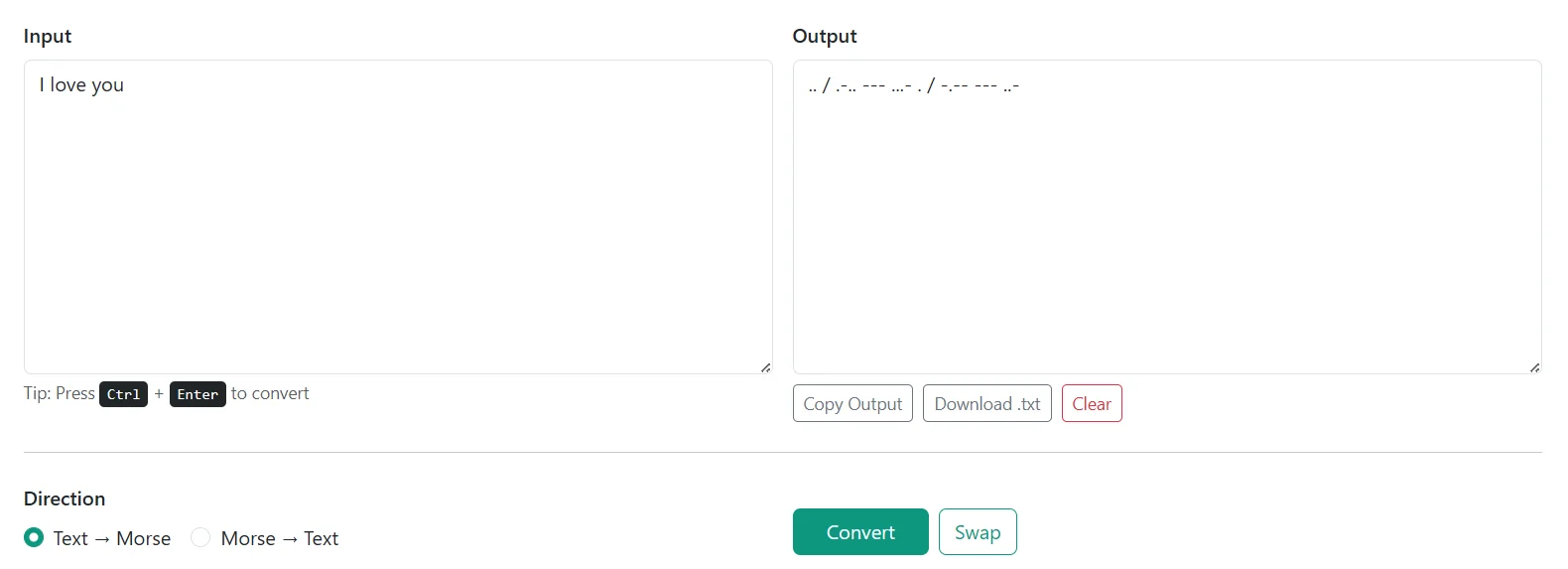
Paste those into the decode field of the tool and you will see how the dots and dashes are transformed back to clear English language. The tool can also be used to decode Morse code to the English text or any other expression of your choice.
Common Mistakes to Avoid
Morse code is very difficult to write or translate without making a few mistakes. The following are some of the most frequent errors, and their prevention:
- Wrong separation between words: Words in Morse code should be carefully separated. The gap between the letters is usually one symbol, and the gap between the words is usually longer. Decoding will not succeed without proper spacing.
- Confusion of dots and dashes: Dots and dashes are similar to each other, which can be confused upon typing or tapping, and may be confused during the translation process by hand. Make sure that you checked your work.
- Lack of attention to punctuation / case: The Morse code is mainly appropriate to letters, numbers and standard punctuations, but rare symbols or special formats may be transmitted wrong. Normal characters should be used to get the best outcomes.
You will have your Morse code translation correct through proper spacing and the use of symbols.
Real-World Data for Morse Code
- The 2025 statement by IARU shows more than 3,000,000 licensed amateur radio operators in the world.
- There are over 160 national member-societies in countries and territories that are part of the global federation.
- Morse code is still used in the modern world. Indicatively, a good number of radio navigation aids are yet to abandon the Morse code identifiers.
- Among radio fans, Morse code is still in use due to its resilience in low signal areas and ease of use in the case of an emergency or a back up communication.
Since there is no recent public info of the exact number of hams who still use Morse code, it is better to state: “Millions of licensed amateur radio operators the world over, some of which still use Morse code. This makes the statement valid and at the same time recognizes the uncertainty.
Conclusion
The morse code could be almost two centuries old yet it is not outdated. Having millions of licensed amateur radio operators all over the world, and still used in navigation and emergency systems, Morse code is an intriguing, helpful system. Want to give it a try? Enter any text (be it a simple greeting such as hello or a highly emotional one such as I love you) into our Morse code generator and translator to create your message in Morse code. It is quick, easy, and fun. Test it now and find out what you can say with only dots and dashes!